

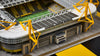

Ask anyone in Marseille for directions to the stadium and they will not say "Orange Vélodrome" or "CEPAC Vélodrome". They will say "le Vel". Names change, sponsors come and go, but for almost ninety years this has been the loud, proud home of Olympique de Marseille.
A stadium for bikes
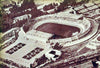
The name gives the origin away. Architect Henri Ploquin designed the stadium in the mid-1930s as a multi-sport ground, with a banked cycling track around the pitch and an athletics track inside it. The first stone was laid in April 1935. On 13 June 1937 the Stade Vélodrome opened with a friendly between OM and Torino, which Marseille won 2-1. About 30,000 to 35,000 people came to watch.
Cycling was a big part of its life. Ten Tour de France stages finished here, and the 1972 Track Cycling World Championships were held on its track. Old fans remember sliding down the steep banking onto the pitch after a win. In 2017 the Tour came back once more, when a time trial started and finished inside the stadium.
World Cups and Euros
Only a year after opening, the Vélodrome hosted matches of the 1938 World Cup, including the semi-final in which Italy beat Brazil 2-1. It was a host city again for Euro 1960 and Euro 1984. In the 1984 semi-final France beat Portugal 3-2 after extra time, one of the great nights in French football.
Over the years the cycling track slowly disappeared. Seats were added in 1971 and the stadium grew. For the 1998 World Cup it was rebuilt to about 60,000 seats, and it hosted seven matches, including the semi-final between Brazil and the Netherlands. In 2004 more than 58,000 fans packed the open bowl for the UEFA Cup semi-final against Newcastle United, a club record at the time. There was one problem: no roof. The mistral, Marseille's strong cold wind, blew straight through the stands, and much of the famous noise blew away with it.
The wave
That changed with Euro 2016. Between 2011 and 2014 the architects of SCAU gave the stadium a complete makeover and, finally, a roof. The white structure rises and falls around the bowl like a wave on the Mediterranean, and at night it lights up. Capacity went up to about 67,000, which makes it the second-largest stadium in France after the Stade de France. The renewed Vélodrome reopened on 16 October 2014.
Two years later Antoine Griezmann scored twice here as France beat Germany 2-0 in the Euro 2016 semi-final. With that match the Vélodrome became the first stadium in Europe to host three European Championship semi-finals.
More than football
The Vélodrome is also a rugby stage. The 2007 Rugby World Cup played six matches here, and in 2024 the Top 14 final between Toulouse and Bordeaux-Bègles drew 66,760 people - the biggest crowd the stadium has ever seen. During the 2024 Paris Olympics it hosted the football tournament under the neutral name "Marseille Stadium".
Names, old and new
From 2016 to 2026 the stadium carried the name Orange Vélodrome. Since July 2026 it has been the CEPAC Vélodrome, after a bank that has supported OM since 1986. Whatever the letters on the façade say, the singing from the Virage Sud and Virage Nord stays the same.
The Vélodrome in miniature
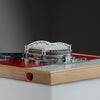
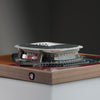
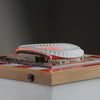
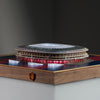
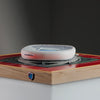
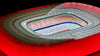
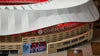
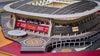
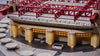
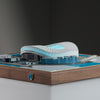
The roof was the challenge of this model. We traced every curve of the wave and lit it from below, so the white shell glows the way it does on a match night by the sea. It is one of the most sculptural stadiums in our collection - a building that looks good from every side.