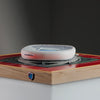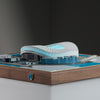

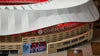


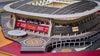
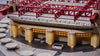


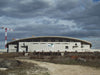
Some stadiums are built from scratch. The home of Atlético de Madrid was built on top of an old dream. Before it became one of the most modern arenas in Europe, the site in the east of Madrid held a half-finished athletics stadium with a single stand that locals called "La Peineta" - the comb.
A stand shaped like a comb
In the early 1990s Madrid wanted big athletics events. The city held a design competition, and architects Antonio Cruz and Antonio Ortiz won it. Construction started in 1990 for Madrid's bid to host the 1997 World Athletics Championships. That bid went to Athens.
The Estadio de la Comunidad de Madrid opened on 6 September 1994 anyway. It had about 20,000 seats, all in one dramatic curved stand on the west side. From the motorway that stand looked like the decorative comb that Spanish women wear in their hair, and the nickname stuck. The stadium hosted athletics meetings, the 2002 IAAF World Cup and even a Supercopa match between Atlético and Barcelona in 1996. But Madrid's Olympic bids for 2012, 2016 and 2020 all failed, and La Peineta closed in 2004.
From the Calderón to the comb
Atlético had played at the Vicente Calderón by the river Manzanares since 1966. The club was ready for something bigger. In 2008 club president Enrique Cerezo and the mayor of Madrid signed an agreement to move. After the 2020 Olympic bid failed, Atlético announced in 2013 that it would turn the empty athletics stadium into its new home. The club sold the Calderón site to help pay for it.
Cruz y Ortiz returned to finish what they had started. They kept the old comb stand, removed the running track and lowered the pitch about 15 metres into the ground. That brought the fans close to the action: the front row is now only a few metres from the touchline. Around the old stand they built a full bowl of steep tiers.
A name with history
The new name was not new at all. From 1923 to 1966 Atlético played at the Stadium Metropolitano in the north of the city. The club won the Cup Winners' Cup in 1962 while it played there. Calling the 2017 stadium "Metropolitano" was a tribute to that first home.
Sponsors added their own part. The stadium opened as the Wanda Metropolitano, became the Cívitas Metropolitano in 2022, and has been the Riyadh Air Metropolitano since October 2024. For most fans it is simply "el Metropolitano".
The crown
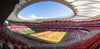
The stadium opened on 16 September 2017 with a 1-0 win over Málaga. Its most famous feature is the roof that Atlético calls "the crown". It is a white membrane made of 96 segments, folded like origami, and it covers almost every seat. On match nights LED lights make the whole roof glow in red and white - it was one of the first stadiums in the world to be lit entirely with LEDs. Today about 70,000 fans fit inside.
Finals and records
The Metropolitano did not have to wait long for big nights. In 2018 it hosted the Copa del Rey final, Andrés Iniesta's last final for Barcelona. On 1 June 2019 Liverpool beat Tottenham 2-0 here to win the Champions League, in front of more than 63,000 people. Earlier that year, 60,739 fans came to a women's match between Atlético and Barcelona, at that time a world record for a women's club game.
More is coming. UEFA has chosen the Metropolitano for the 2027 Champions League final, and Spain has put it forward as a venue for the 2030 World Cup.
The Metropolitano in miniature
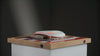
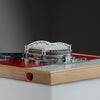
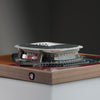
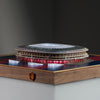
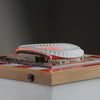
For our model, the roof was everything. We rebuilt the folded crown segment by segment and placed mini-LEDs so it glows red, just like on a Madrid match night. Look closely and you can still find the curve of the old comb stand in the west side - the part of the story that started it all.