
"Més que un club" - more than a club. For decades those words were spelled out in yellow seats across the stands of Camp Nou, the largest stadium in Europe. The home of FC Barcelona has seen popes, World Cups, Champions League finals and some of the greatest players who ever lived. And right now, it is in the middle of the biggest transformation in its history.
Too small for Barça
In the 1940s and early 1950s Barcelona played at Camp de Les Corts, a stadium that had opened in 1922. It had been expanded again and again, but there was no more room to grow. The arrival of the Hungarian star László Kubala in 1950 made the problem worse: everybody wanted to see him play, and Les Corts could not hold them all.
In 1950 the club bought land in the west of the city, near the Maternitat area. On 28 March 1954 the first stone was laid, in front of about 60,000 people. The architects were Francesc Mitjans Miró and Josep Soteras Mauri, working with Lorenzo García-Barbón. Their design was bold for its time: a huge open concrete bowl with two steep tiers and no pillars to block the view.
Building it was a financial adventure. The budget was about 66 million pesetas. The final bill was about 288 million - more than four times the plan. It took the club years to pay off the debt.
Opening day, 24 September 1957
The stadium opened during La Mercè, Barcelona's biggest city festival. Barça played a team from Warsaw and won 4-2. The Paraguayan forward Eulogio Martínez scored the first goal in the eleventh minute. More than 90,000 people were there.
Officially, the stadium was called the "Estadio del Club de Fútbol Barcelona". But fans called it "Camp Nou" - the new ground - from the very beginning, as opposed to the old ground at Les Corts. It took until 2001 for the club to make it official: in a vote, 68 percent of the members chose "Camp Nou" as the real name. Since 2022 the stadium carries the name of its sponsor: Spotify Camp Nou.

The World Cup and the Pope
Floodlights were installed in 1959 and an electronic scoreboard in 1976. The big growth came in 1982, when Spain hosted the World Cup. Camp Nou got a third tier with more than 22,000 extra seats, which took the capacity to about 120,000. It hosted the opening match of the tournament, in which Belgium surprised the champions Argentina, and the semi-final in which Italy beat Poland on the way to the title.
A few months later, in November 1982, Pope John Paul II held a mass in the stadium for more than 120,000 people. Two years after that, in 1984, the club opened its museum. Today it is one of the most visited museums in the city.
Two finals to remember
Camp Nou has hosted two European Cup and Champions League finals. In 1989 AC Milan, with the Dutch trio Ruud Gullit, Marco van Basten and Frank Rijkaard, destroyed Steaua Bucharest 4-0. And in 1999 came one of the most famous endings in football history. Bayern München led Manchester United 1-0 until the 90th minute. Then Teddy Sheringham and Ole Gunnar Solskjær scored in stoppage time, and United won 2-1.
A third final is on its way. UEFA has chosen the Spotify Camp Nou for the 2029 Champions League final, when the club expects the rebuilt stadium to hold more than 104,000 people.
Camp Nou also hosted the football final of the 1992 Olympic Games - the Games that Barcelona won, ahead of Amsterdam. And in 2016 a French rugby final drew more than 99,000 people.
The home of legends
The list of players who called Camp Nou home reads like a history of football itself: Kubala, Johan Cruyff, Diego Maradona, Ronald Koeman, Romário, Ronaldo, Rivaldo, Ronaldinho, Xavi, Iniesta and Lionel Messi. For Dutch fans the stadium has a special place. Cruyff arrived as a player in 1973, returned as a coach in 1988 and built the "Dream Team" that won Barcelona's first European Cup in 1992. Koeman scored the winning goal in that final. Later, Louis van Gaal and Frank Rijkaard both coached the club, and Rijkaard won the Champions League in 2006.
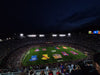
Many of the club's greatest nights were El Clásicos against Real Madrid. For years more than 90,000 people - sometimes almost 100,000 - watched these matches inside Camp Nou.
Goodbye, old Camp Nou
In the 1990s the pitch was lowered and the standing areas were removed. The stadium became all-seated, with a capacity of just under 100,000. It was still the biggest stadium in Europe, but it was getting old. The concrete needed repairs, there was no roof over most seats, and the facilities were far behind those of newer stadiums.
In 2014 the club members voted to rebuild the stadium instead of moving to a new one. The project was called Espai Barça. The Japanese firm Nikken Sekkei and the Barcelona office Pascual i Ausió Arquitectes won the design competition in 2016.
On 28 May 2023 Barça played the last match in the old stadium. Days later, the demolition of the third tier began. For two seasons the team played at the Olympic stadium on Montjuïc.
The return
On 22 November 2025 Barcelona came home. More than 45,000 fans watched a 4-0 win over Athletic Club in a stadium that was still a building site. Since March 2026 the stadium may hold about 62,000 people. The new third tier and the roof are still under construction. The roof is planned for 2027, and the club expects the full capacity of about 105,000 seats around 2028. The rebuild has become one of the most expensive stadium projects in the world, at a total cost of about €2 billion.
The last steps are still ahead. In September 2026 the club's delegates approved another €510 million to finish the works and to cover the cost of the delays. The new third tier will stay closed for the whole 2026-27 season. To install the roof, the stadium needs about four months without matches, so Barça will have to move out once more at the start of the 2027-28 season. If everything goes to plan, the team returns around January 2028 to a stadium for about 95,000 people, and reaches the full capacity before the 2028-29 season. The completion date has moved several times since the start of the project, so Barcelona fans have learned to be patient.
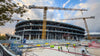
When it is finished, the new Camp Nou will have a roof that covers the stands and a completely new façade. Barcelona will once again have the largest stadium in Europe.
Camp Nou in miniature
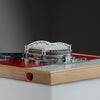
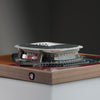
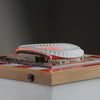
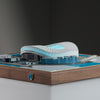
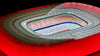
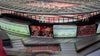
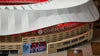
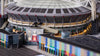
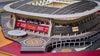
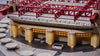
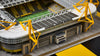
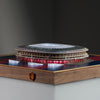
Our model of the Spotify Camp Nou captures the stadium as it is today - in the middle of its rebuild, with the new façade taking shape around the historic bowl. It is a snapshot of a moment that will not come back: the old Camp Nou turning into the new one. The mini-LEDs light up the stands like a Champions League night, and the sheer size of the bowl makes it one of the most impressive pieces in our collection. More than a stadium - just like the club.