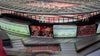
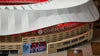
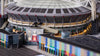

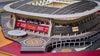
Galatasaray fans call it "Aslantepe" - Lion's Hill. The stadium on the hill in the north of Istanbul has carried four sponsor names in fifteen years, but its reputation has never changed: this is one of the loudest places in world football.
Leaving Ali Sami Yen
For almost half a century Galatasaray played at the Ali Sami Yen Stadium in Mecidiyeköy, in the middle of the city. It opened in 1964 and became famous for its tight stands and its "Welcome to Hell" banners for visiting teams. But the old ground was small and hard to expand. In 2007 the club and TOKİ, the Turkish state housing agency, agreed a deal: the old site in exchange for new land in Seyrantepe, close to the ring road.
Work started on 13 December 2007. It was not a smooth build. In 2009 the first contract was cancelled and a new construction team took over. The design came from an international competition, won by the German office 'asp' Architekten Stuttgart, with structural engineers Schlaich Bergermann Partner. A Dutch team from Amsterdam ArenA Advisory also helped with the project.
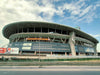
Opening night, against Ajax
The new stadium opened on 15 January 2011 with a lion-themed show and a friendly against Ajax from Amsterdam. The match ended 0-0, but nobody remembers the score. They remember the noise. Galatasaray had moved, and the atmosphere had moved with them.
The last official match at the old Ali Sami Yen had been played only three days earlier, on 12 January 2011. The Lion had a new den within a week. For a Dutch brand it is a nice detail too: the first visitors on the hill came from Amsterdam, and Dutch stadium experts had helped to shape the building.
A world record for noise
Two months later the stadium made history. On 18 March 2011, during the Istanbul derby against Fenerbahçe, an official from Guinness World Records measured the crowd at 131.76 decibels - the loudest crowd roar ever measured at a sports stadium at that time. American football fans in Seattle and Kansas City later beat the record, but the Galatasaray roar is still the benchmark in European football.
The design helps. The two tiers are steep, the corners are closed and the roof keeps the sound inside the bowl. About 52,000 fans fit in, and on derby days it feels like many more.

Four names, one home
The official name has always been Ali Sami Yen Spor Kompleksi, after the founder of the club. Sponsors gave it a second name: Türk Telekom Arena from 2011, Türk Telekom Stadyumu from 2017, Nef Stadyumu from 2021, and since July 2023 Rams Park. Fans chose the final form of the newest name in a poll.
Big nights on the hill
The stadium has seen Champions League evenings against Real Madrid and Juventus - the Juventus match in December 2013 had to be stopped because of heavy snow. It hosted the final of the 2013 FIFA U-20 World Cup, concerts by Bon Jovi and Madonna, and it is a candidate venue for Euro 2032. In 2027 the Spanish Supercopa final is set to be played here.
A stadium powered by the sun
In 2021 and 2022 the club covered the roof with more than 10,000 solar panels. With a capacity of over 4 megawatts, Guinness World Records recognised it as the most powerful solar-powered stadium in the world. In 2025 the stadium also got new giant screens and LED boards.
Rams Park in miniature
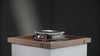
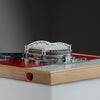
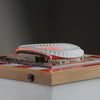
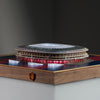
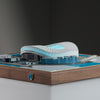
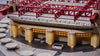
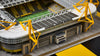
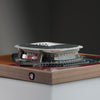
A stadium on a hill needs its landscape. That is why our model of Rams Park includes the surrounding hills and the ring road of Istanbul, with the stadium sitting on top like a crown. The mini-LEDs light the bowl from inside - you will have to add the noise yourself.