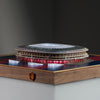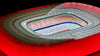
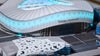
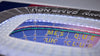
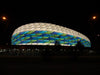
Drive north out of Munich on the A9 at night and you cannot miss it: a huge glowing shape in the fields, red when Bayern play at home. Locals call it the "Schlauchboot" - the rubber dinghy. The rest of the world knows it as the Allianz Arena, one of the most recognisable stadiums ever built.
Two clubs, one vote
For decades Bayern München and TSV 1860 München played at the Olympiastadion, the tent-roofed stadium of the 1972 Olympics. It was beautiful, but the running track kept fans far from the pitch. Both clubs wanted a real football stadium. On 21 October 2001 the people of Munich voted in a referendum, and almost two thirds said yes.
The design competition was won by the Swiss architects Herzog & de Meuron, with engineers from Arup. Construction started in October 2002, and the stadium was handed over at the end of April 2005. The total cost, including financing, was about €340 million.
A skin of air
The big idea was the façade. Instead of concrete or steel, the stadium is wrapped in about 2,800 diamond-shaped cushions of ETFE, a plastic foil only 0.2 millimetres thick, filled with air. Each cushion can be lit from inside. At first the lights could show only three colours: red for Bayern, blue for 1860 and white for the national team. The police even asked the club to keep one colour per match, so that drivers on the motorway would not be distracted.
In 2015 the old fluorescent tubes were replaced by more than 300,000 LEDs. Since then the façade can show millions of colours and moving patterns, while it uses more than 60 percent less energy.
Opening nights
The Allianz Arena opened on 30 May 2005 with a match for TSV 1860. One day later Bayern played the German national team and won 4-2. At first the two clubs each owned half of the stadium, but in 2006 1860 sold its share to Bayern. The Lions stayed as tenants until 2017. After that the interior was redone in Bayern red.
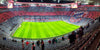
Today about 75,000 fans fit inside for Bundesliga matches. It is the second-largest stadium in Germany, after Dortmund's Signal Iduna Park. Since 2025 its address is Franz-Beckenbauer-Platz 5 - the number of the shirt that "Der Kaiser" wore.
Finals at home, won and lost
The stadium was ready just in time for the 2006 World Cup. Germany opened the tournament here with a 4-2 win over Costa Rica, and France beat Portugal in the semi-final. In 2024 it hosted another opening match, when Germany beat Scotland 5-1 at the start of Euro 2024.
The night Bayern fans prefer to forget is 19 May 2012. The Champions League final was played in their own stadium, against Chelsea. Bayern led until the 88th minute, Chelsea equalised and then won on penalties. In 2025 the Arena hosted another Champions League final, in which Paris Saint-Germain beat Inter 5-0. The 2028 final will be played here too.
More than men's football
In 2022 the stadium hosted the first regular-season NFL game ever played in Germany, in front of almost 70,000 fans. The stadium also has its own FC Bayern Museum, which welcomes hundreds of thousands of visitors every year. And in September 2025, 57,762 people came to watch FC Bayern Women - a record for the German women's league.
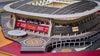
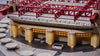
The Allianz Arena in miniature
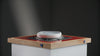
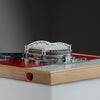
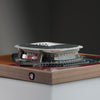
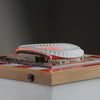
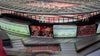
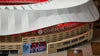
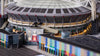
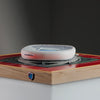
This is a model that is all about light. We rebuilt the diamond pattern of the façade and placed mini-LEDs behind it, so the whole shell glows the way it does from the motorway. Turn off the lights in the room and you have your own piece of Fröttmaning at night.